



Showing all pages regarding networking.
What networking is not

What do you think of when you hear the word ‘business networking’? A crowded reception room full of anonymous faces? Grappling with drinks and canapés while trying to make small talk? People frantically ‘working the room’ and exchanging business cards? It’s not a positive image is it? But the truth is this image continues to discourage people who know they should network but somehow never get round to it. The trouble is, our assumptions about networking misrepresent the reality. So let’s correct those negative thoughts right now!
Networking is not about:
• Attending numerous receptions and events in the hope of making a few tentative connections;
• Arrogance, self-promotion or pretending to be someone you’re not;
• Collecting business cards, connections on LinkedIn, followers on Twitter or friends on facebook.
And believe it or not, networking is not all about YOU!
I once attended a business lecture about ‘Effective Networking’ held in the Middle East. The presenter was the owner of a business club and was clearly there to promote his club as a place to network and do business. I was so dismayed by his views on the subject of networking that I wrote down what he said, word for word.
“When you are networking, do keep your face in everyone else’s and make sure everyone in the room knows who you are and what you do by the end of the night.”
Would you really like to meet someone who behaved like this at an event you were attending? Perhaps you have experience of people who take this approach to networking. Take my word for it; this sort of behaviour does not work! Of course it’s useful to attend networking events if they are relevant, and exchanging business cards on these occasions is customary practice. There are also times when it’s important to do a bit of self promotion when networking. But in my view none of these activities help to define the concept of networking.
What networking is
This is my preferred definition:
Networking is about building reciprocal relationships with people you like, admire and trust.
If you can exchange your negative perception of networking with my new improved definition then, I promise you, the whole idea will become much more appealing and manageable.
Does this description of networking really apply in all situations? Some might argue that you can’t adopt this attitude in a hard-nosed sales environment where the sole object is to get business regardless of the personalities and without any intention of building a long term relationship with customers. Well, I concede that there are some occasions in certain business contexts where we have to do business with people we don’t like. I also accept that, in some sales environments, there is no requirement or even opportunity to build lasting business relationships with clients. However, I would argue that these situations are increasingly rare. And I maintain that the general aim in networking should always be to build relationships with people you like admire and trust. If you do, you are likely to be a more successful networker in the long term.
When I look at my networks and consider the business relationships that have been most valuable to me over time, I realise that my (often subconscious) decision to put effort into building a relationship with another person is influenced by at least one of six factors.
1. I like the other person.
2. I am interested in or respect them.
3. I think I could learn from them.
4. I think they could help me.
5. I want to help them.
6. I trust them.
So think about these six factors when you network and be open to forging new relationships with a wide spectrum of interesting people. You can be a great and effective networker without ever having to attend another drinks reception!
This is an excerpt from Jeanette’s book “No Nonsense Networking” – click here for a free download. http://jeanettepurcell.com/no-nonsense-networking-six-steps-raising-profile/
5 reasons why networking matters

There are many reasons why you should aim to be an effective networker. It’s good for you, it’s good for your career and it’s good for your business. What’s more, if you approach networking with the right attitude you will enjoy the activity and want to do it more. Here are my top five reasons why you should aim to be a great networker:
Reason #1 – We do business with people we like and trust
It’s popular to believe that buying has become a depersonalised activity and that the hiring of staff is based purely on an objective assessment of a candidate’s skills. But the evidence is that, even today, most transactions in business are about relationships. We do business with people we like and trust. You can achieve a certain amount through marketing and advertising campaigns and it is possible for selling to be a completely anonymous business, but at some stage your customer, client or prospective employer is likely to come face to face with YOU. Their decision to buy or hire will be influenced by a range of factors which, at some level, will almost certainly include how much they like and trust you. Relationships are at the heart of any successful business. And so it is important to invest time in making connections, building relationships and maintaining those connections over time.
Reason #2 – Word of mouth marketing really works
I have been running a business for several years and ALL of my clients have come to me through word of mouth. Now, that’s not unusual for my type of business but all companies, regardless of size or industry, rely to some extent on word-of-mouth marketing.
Surveys into the impact of online marketing show that peer recommendation is the most trusted form or advertising, whereas online search, banner advertising and other ads are among the least trusted (NIELSEN – Global Online Consumer Survey – July 2009). Even with the explosion of online review applications (eg, Yelp, Google, Urbanspoon), research clearly demonstrates that word of mouth—product recommendations made by family, friends, work colleagues, or neighbours —is still the most effective way to win new customers. (The Harris Poll #74, June 3, 2010). At the same time, many people fail to recognise the value of customer referrals and the power of networking as a form of word-of-mouth marketing.
Reason #3 – Being good at your job is not enough
Like it or not life is not a meritocracy. The truth is that your skills, qualities and experience are likely to go unnoticed unless you are prepared to promote yourself. This means seeking opportunities to communicate what you have to offer and your career aspirations. I’m not talking about trotting out a sales pitch to everyone you meet, but I am suggesting that a more proactive approach to advancing your career is required. And this involves building a useful supportive network.
Reason #4 – Well connected people are ‘in the know’
The surest way to pick up on a new opportunity – whether it’s a new client, new job or changes in your market – is to be well connected. How many times have you heard about a job vacancy or a potential new project through a friend or work colleague? The grapevine is a wonderful and powerful communication channel and you should use it. By developing your networks you not only stand a better chance of knowing what’s going on but you are also more likely to be remembered when one of your connections wants something that you offer. Networks are vital as a means of sharing knowledge and information. What’s more, a good networker who enjoys meeting and learning about other people will broaden their outlook and develop a useful body of skills and knowledge, making them an interesting person to know.
Reason #5 – Networks are a valuable source of support
Networking is not just about finding opportunities and advancing your own interests. A good network is one that is based on give and take, trust and respect. There are people in my network who I know I can ask for help when I am thinking through a new idea or dealing with a particularly difficult problem. And they know I will do the same for them in return. If you build your network in the right way, you will find that it can be a valuable source of support and advice.
This is an excerpt from Jeanette Purcell’s “No-Nonsense Networking” – 6 steps to raising your profile.
No-Nonsense Networking:
Six Steps to Raising Your Profile
A free eBook by Jeanette Purcell
Through thirty years of experience in business and academia and countless conversations with great networkers, I have observed that surprisingly few people network effectively. Yet good networking skills are essential if you want to get on in business and have a fulfilling career.
This is why I wrote this book. 22 pages full of practical tips and ideas on how to build long-lasting successful business relationships. It is for anyone who wants to grow their business, extend their business networks or raise their profile within their profession or working environment. If you are looking for a job or preparing for promotion, this book is also for you.
In No-Nonsense Networking, I take you through a practical approach to building a successful network in six easy steps:
1. Developing the right attitude.
You need to approach networking in a positive frame of mind. We debunk some of the myths about networking and deal with the common issues that hold people back from being enthusiastic and confident networkers.
2. Preparing your pitch.
With the right attitude and a clear idea of what you want to achieve from your networking you are ready to write your ‘pitch’. We look at how to tell your story and present your skills in a concise, positive and memorable way.
3. Managing your existing networks.
It’s not only about making new connections but also about managing your existing contacts. How well are you managing and tapping into your existing networks?
4. Preparing to network.
Successful face-to-face networking begins with thorough preparation. We will cover the preparation required for every networking situation.
5. Networking events.
From social gatherings to business meetings we look at how to manage networking situations, make the right connections and get results.
6. Building and maintaining the relationship.
Truly successful networks require maintenance. We consider the follow up required to convert a new connection into a productive business relationship and how to sustain and grow your networks over the long term.
Each step is explained in comprehensive detail, with achievable exercises at the end of every section. After reading this book, you will be better equipped to network confidently, successfully and intelligently.
Download for free
You can download this eBook for free from any of the following sources (click on the icons to open in a new window).



Download for free from Amazon Kindle Store, iBooks or as a PDF
About the author
Jeanette Purcell is the founder and Managing Director of Jeanette Purcell Associates, specialists in leadership development and change management. She is a leadership specialist, providing coaching, lecturing and consultancy services in all aspects of leadership development and organisational change. Her focus is on giving leaders and their organisations practical solutions that have a measurable impact on performance.
Jeanette is a Visiting Lecturer at Cass Business School and has over 30 years practical experience in management and business leadership. Until establishing her own business, Jeanette was Chief Executive of the Association of MBAs (AMBA), the global accreditation agency and network for MBA students and graduates. In this role she succeeded in raising the profile of the MBA as the premier qualification for business leaders and developed a range of services and support for MBA graduates throughout the world.
Jeanette is an accomplished international public speaker. She presents and writes on issues relating to leadership, business development and business education and has been instrumental in the delivery of Cass Leadership programmes in Dubai. Current corporate clients include Pfizer International where Jeanette delivers ‘networking skills’ training to high potential female managers.
In 2013 Jeanette founded the Brain Exchange, an exclusive forum for business professionals to exchange advice, knowledge and support in a confidential and professional environment. The Brain Exchange meets monthly in London and is achieving growing recognition as a high quality business network.
It’s networking Jim, but not as we know it

I was coaching a client this week who recently became self-employed after working as a project manager for many years. She had already completed a couple of jobs on a freelance basis and there were more in the pipeline. “The thing is” she said “all the work I’ve done so far has come through word of mouth. At some point I will have to advertise and do some real marketing”. I queried this with her, suggesting that she must have some great networks that she could tap into for more business. “Ah, but I’m no good at networking” she replied “I haven’t got time to go to all those events and anyway that sort of thing scares me!”.
Now, this conversation highlights two very common misunderstandings about networking.
The first misunderstanding is that acquiring business through word of mouth is somehow not ‘real’ marketing. More than that, there is a tendency to assume that referrals or personal recommendations are more about luck than successful marketing. Absolutely not! You don’t get referrals unless you have a great reputation and can be trusted to do a good job. If you are proactive about maintaining the relationships that you have with people in your industry you will find that these relationships lead to new connections and new business. Word of mouth is THE most important form of marketing for small businesses. Don’t dismiss or ignore it!
The second misunderstanding is that networking is all about going to events, receptions and conferences. Most people will tell you that they associate the word ‘networking’ with the experience of walking into a drinks reception full of people they don’t know and being expected to ‘work the room’ (dreadful phrase). I can’t remember the last time I went to a networking event and yet I am networking all the time. Yes, you’ve got to get out there and meet people to build your business, and you’ve got to do some selling. But you don’t have to attend events or put yourself into unfamiliar situations to achieve this. Networking is about building relationships with people you like, admire and trust. Start building your networks by talking to people who already know and love you. Ask them for advice, ask them for introductions to people who might want what you’re selling. This form of networking is ten times more successful than cold calling, expensive advertising or collecting a few random business cards at a networking event.
My client visibly relaxed when she thought about networking differently. It’s not hard work, it needn’t be scary, but good networking is essential to developing your business.
Don’t miss JPA’s Master Class “Positive Impact and Confident Networking” on 25 February 2014. Early bird booking discount applies until 28 January 2014. Find out more here http://jeanettepurcell.com/jpa-master-class-series/
20 Networking Tips

This week I ran a one day workshop in Stockholm for senior women managers in Pfizer. The workshop is part of a company-wide initiative to support and encourage women within Pfizer who have leadership potential – a great example of effective talent management. The subject of the workshop was ‘Visibility & Networking in Pfizer’ and we spent time discussing some common anxieties about networking and how to overcome them. It was a fantastic day and brought home to participants the value of networking, the importance of making it personal and of nurturing relationships. What a pleasure to work with a great group of women with plenty of ideas and enthusiasm! I reckon Pfizer will soon reap the benefits of this particular investment.
Do you need help with networking or some networking tools? Have a look at my workshop handout ‘JPA’s 20 Networking Tips’ – it’s based on years of experience!
The buzz about the Brain Exchange

One cold January day back in 2013 I was chatting to a business colleague about the joys of self employment after years of working for large organisations.
“But do you know what I don’t like about running my own business?” I said. “It’s that there is no one to talk to when I need to make a big decision or when I am thinking through a new idea or problem. Wouldn’t it be great if we could get access to some peer group support once a month, where we can do some ‘thinking aloud’ with other business people?”
As we talked, it became clear that my complaint was quite common among people who were either self-employed or running small enterprises. And we realised that, although there are many business groups and networks in existence, none of them addressed this particular problem. And that is how the Brain Exchange started.
Today the Brain Exchange is a regular fixture in Central London attended by growing numbers of people from different walks of life and backgrounds. Here’s how it works….
What is the Brain Exchange?
The Brain Exchange is a unique forum for business professionals to share experiences, exchange knowledge and find inspiration within a confidential and supportive environment. It’s not just a network or a talking shop – each meeting of the Brain Exchange is professionally facilitated to ensure that discussions are structured and focused on achieving results.
Who is it for?
Brain Exchange members are senior professionals working in a diverse range of roles and sectors. Current members include CEOs, entrepreneurs, social enterprises, freelancers, small business owners and senior managers.
How does it work?
Meetings of the Brain Exchange are held monthly in London from 18.30 to 20.30. There are eight spaces available at each meeting and places are reserved on a first come first served basis.
With direction from a professional facilitator, the group spends one hour exploring an issue presented by a group member who volunteers for the ‘hot seat’. The discussion follows an agreed structure to encourage full participation and the consideration of all view points. The final part of the discussion is focused on drawing conclusions from the discussion and identifying possible actions. The formal part of the meeting is followed by drinks and networking.
All discussions are strictly confidential so that members can be completely and honest about the problems that keep them awake at night.
What are the benefits?
If you’re in the ‘hot seat’ you benefit from what is in effect an hour of business coaching. But everyone benefits from being part of the discussion. All participants get:
- Eight different perspectives on an idea or problem
- New ideas for your business and new approaches to business problems.
- The opportunity to step back and reflect on your situation, your business and the future
- Access to support from fellow professionals in a confidential environment.
- New networks and business connections
- The opportunity to learn from others with different skills, knowledge and areas of expertise
What are people saying about the Brain Exchange?
“It’s like having a ready-made super-professional Advisory Board”
“The meetings are professional and focused – you get real value in less than two hours.”
“For my family-run business it’s a way of tapping into expertise and experience that we don’t have inside the company.”
“I gained a lot from being in the hot seat – I came away with solutions and ideas for re-energising my business.”
“Knowing that other people experience the same problems is so reassuring.”
“It’s like business-coaching but with added benefits!”
How can I join?
Membership of the Brain Exchange is by invitation only. You can be introduced by an existing member or apply direct to the Brain Exchange by contacting Jeanette Purcell. You should ideally have senior level business experience, be willing to share your experiences and ideas and be a good listener.
What’s the buzz? It’s the Brain Exchange.
For more information see http://jeanettepurcell.com/brain-exchange/
A knowledge-sharing forum for business professionals
The Brain Exchange is a unique forum for business professionals to share experiences, discuss concerns and find solutions and inspiration within a confidential and supportive environment.
It’s not just a network or a talking shop – each meeting of the Brain Exchange is professionally facilitated to ensure that discussions are structured and focused on achieving results.
Who is it for?

Brain Exchange members are senior professionals working in a diverse range of roles and sectors. Current members include CEOs, entrepreneurs, freelancers, small business owners and senior managers.
How does it work?

Meetings of the Brain Exchange are held monthly in London from 18.30 to 20.30. There are ten spaces available at each meeting and places are reserved on a first come first served basis.
At each meeting a member of the group volunteers for the ‘hot seat’. They will outline to the group an idea, a problem or challenge that they are facing – anything that they would like to share with the group. With direction from a professional facilitator, the group spends one hour exploring the issue, giving feedback and making suggestions. The discussion concludes with the person in the ‘hot seat’ summarising their learning from the discussion and determining what actions they will take.
The formal part of the meeting is followed by drinks and networking.
All discussions are strictly confidential.
What are the benefits?

If you’re in the hot seat you are effectively getting an hour’s worth of business coaching. But everyone benefits from being part of the discussion. All participants get:
- Eight different perspectives on an idea or problem
- New ideas for your business and new approaches to business problems.
- The opportunity to step back and reflect on your situation, your business and the future
- Access to support from fellow professionals in a confidential environment.
- New networks and business connections
- The opportunity to learn from others with different skills and areas of expertise
What are people saying about the Brain Exchange?

“It’s like having a ready-made super-professional Advisory Board”
“The meetings are professional and focused – you get real value in less than two hours.”
“For my family-run business it’s a way of tapping into expertise and experience that we don’t have inside the company.”
“I gained a lot from being in the hot seat – I came away with solutions and ideas for re-energising my business.”
“Knowing that other people experience the same problems is so reassuring.”
“It’s like business-coaching but with added benefits!”
How can I join?
Membership of the Brain Exchange is by invitation only. You can be introduced by an existing member or apply direct to the Brain Exchange by contacting Jeanette Purcell at jeanette@brainexchange.co.uk, or simply use the form below:
You should have senior level business experience, be willing to share your experiences and ideas and be a good listener.
How much does it cost?
Information about membership fees is available on www.brainexchange.co.uk
How do I sign up?
Go to www.brainexchange.co.uk
When is it next on?
The Brain Exchange will next be meeting on the following dates. Go to www.brainexchange.co.uk to register:
- 13 April 2016
- 11 May 2016
- 15 June 2016
- 13 July 2016
How to be an engaging conversationalist

How many times have you had a conversation with someone whose opinion about you really matters and walked away feeling dissatisfied about how it went? Sometimes we fail to present ourselves positively or forget to mention a really important point. Other times we might feel we lost the opportunity to build a rapport with the person. Were you aiming to build a better working relationship with them? If so, how likely are they to want to talk to you again?
There are many work situations where the pressure is on to make a positive impression during a short conversation – these include interviews, networking events and meeting a new boss. I’m interested in the conversations where the objective is to build a rapport and develop a positive working relationship. You might want to get to know an influential, senior person in your organisation. Or perhaps you are working on a project with a client and want to extend your networks to the key decision makers within the company. Let’s say you’ve arranged a meeting with that all important influential person. Great! That’s the first step. Now, how can you make the most of this opportunity to impress?
First be clear about the objective of the conversation and prepare for it. Anticipate their questions and have some answers ready, or rehearse the way you will present your ideas. If there is no particular agenda then treat this as an opportunity to do some fact-finding. This is a great way to demonstrate interest in the person, their role and their objectives. It involves a lot of listening and the use of intelligent questions. Here’s a useful crib sheet for this type of conversation. I have used this on many occasions to help high-flying Executives who find themselves lost for words when it comes to small talk! It’s very simple and surprisingly effective.
1. Open with a brief introduction and explanation for the discussion. “I’m interested in getting some feedback on X” or “I’d appreciate some advice on X” or even “I’m on a fact-finding mission..”
2. Use open questions. (Who? What? Why? How? When?) “Why do you think that’s happening?” or “Who would be a good person to speak to about that?” or “What do you think would improve that situation?”
3. Use affirmative statements. “I see” or “that’s interesting”
4. Check your body language. Smile, nod or show concern as appropriate. Keep an open posture (arms uncrossed, lean forward), maintain some eye contact and don’t fidget!
5. Explore the relevant issues further. Direct the conversation by picking up on points that are useful to you. “Can you expand on that?”
6. Clarify and check understanding. “So, if I have understood this correctly…” or “so I think you’re saying that….” Or “so just to be clear…”
7. Summarise and suggest next steps. “So, can I just recap – (points a, b, and c)” or “I’d like to come back to you by (date)…with some options…”
8. Thank them! “I really appreciate you taking the time to see me. It’s been very useful.”
Every situation is different and you’ll need to use some judgement about what is appropriate or effective in each case. The point is, be prepared to listen and fully attend to the other person – sounds easy but very few people can do this well.
For more listening tips see JPA’s Top Ten Tips for Effective Listening.
Top Ten Tips for Effective Listening
Are you listening to your clients?

I was talking to a group of business people recently on the subject of winning and keeping clients. We agreed that face to face conversations with clients are the best opportunity you have to win them over. It’s a shame then, that this critical stage in the process is often poorly managed. When we’ve done all our marketing and networking and have actually got a hot prospect who is willing to sit down and have a discussion with us, we go and mess it up. Why is this? Most of the time it’s because we are so intent on selling our product or idea that we forget to listen. Remember, the aim is not to dump information on the client. Rather, the intention is to identify what their problem or challenge is, show how your product or service can help them and then elicit a positive response.
So a large part of the conversation will involve listening to the client, asking them questions and being interested in what they are saying. Sounds easy doesn’t it? It’s not. Listening patiently is hard – we are all too eager to say our piece and jump in with our solutions. But if you can spend time allowing your client to talk, and being genuinely interested, they will be delighted and impressed. And that’s how you begin to establish a sustainable trusting relationship – the kind of relationships that are more likely to bring you business. Because we tend to do business with people we like and trust.
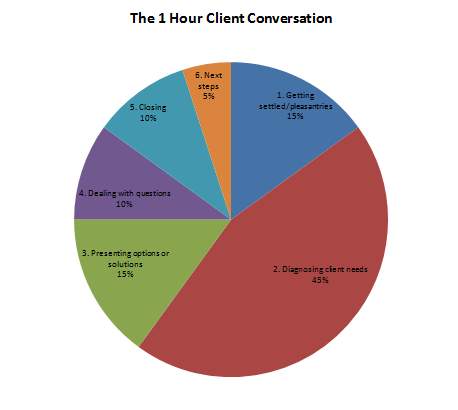
(copyright Jeanette Purcell Associates)
A colleague of mine, Jamie Hancox of ‘buyingtime’ (http://www.buyingtime.co.uk/), gave me the idea of describing the perfect client conversation. So I created this diagram to show the key stages of the discussion (see above). This format is not intended to be prescriptive. It simply illustrates just how much time is spent on understanding the client and diagnosing their needs. Of course, you still have to describe the benefits of what you do and you have to close the sale (it’s all too easy to shy away from this crucial bit!) but those parts take up relatively less time.
Remember, companies do not make the decision to hire or buy. People do. The relationship you build with people in your client organisations is crucial to your business. Try listening, it’s very effective.
How personal impact can make the difference

As a Trustee of a Community Trust in South East London I was recently involved in the appointment of a full-time youth worker. There was a lot of interest in the position and interviews were held with six short-listed candidates. The interview panel asked each candidate the same questions and carefully scored each person against their ability to meet the requirements of the job. At the end of a long day two candidates stood out from the others and both had achieved exactly the same score. How to choose between them?
The interview panel began to discuss which candidate came across best in the interview. We discussed ‘likeability’ – something that’s hard to define but often referred to as ‘personal impact’. For two candidates, both equal in terms of their skills and experiences, it was the positive impact they made with the panel that made the crucial difference. What does personal impact mean and how do we know it when we see it? There are probably three key factors that help to achieve personal impact:
- A smile is so important – it conveys warmth and enthusiasm. When you smile you are letting others know that you are feeling positive and enjoying their company.
- Positive body language. The candidate we interviewed who sat back in the chair with their arms folded was less engaging than the one who sat forward keeping an open posture. A little animation when you are talking helps to demonstrate eagerness and interest in the discussion.
- Authenticity. People who come across as genuine, honest and human almost always generate a positive response from others. Be yourself, admit your weaknesses (we all have them!), show genuine concern and interest in what you do. Others will believe in you and warm to you as a result.
Personal impact is not easy to define, but with some attention to the way you look, move and talk it can be acquired. What’s more, it is as important to a youth worker as it is to any leader. Skills and experience can get you so far, personal impact makes the difference.
DON’T MISS THE JPA MASTER CLASS “PERSONAL IMPACT AND CONFIDENT NETWORKING” ON 10 DECEMBER 2013.
VISIT www.jeanettepurcell.com/jpa-master-class-series/ FOR MORE DETAILS.
About Jeanette

Jeanette has over 20 years experience in management and was Chief Executive of AMBA for 7 years. She has worked in both the commercial and public sectors. Having completed her MBA (with distinction) at the Cass Business School, Jeanette was asked to join the school's academic team as a Visiting Lecturer in Organisational Behaviour... [read more]


Latest posts from my blog

How to get the most out of Executive Coaching
Take these steps to ensure Executive Coaching achieves noticeable, positive and long-lasting change

What work teams can learn from Natalia Cohen
If 4 women in a small boat can avoid conflict for 257 days so can work teams! Here's how.

Five steps to choosing the right Executive Coach
Executive Coaching can be a smart investment. Here are my top 5 tips to help you choose the right coach.

Three essential questions to kick start 2016
Planning time is time well spent – it will help you to remain focused on the those activities that are really important and to work effectively, avoiding stress and maintaining your work/life balance.

What networking is not
What do you think of when you hear the word ‘business networking’? Our assumptions about networking need to change before we can network effectively.

5 reasons why networking matters
Developing networking skills should be a priority for anyone in business. Why does networking matter?

How to be a versatile leader
Do you have the ability to understand people and situations and to adopt different leadership styles in response?

Top 3 tips for improving your time management skills
When the going gets tough what can we do to stay focused and fully in control of our time.?

Lessons in responsible leadership
Rebekah Brooks said she had “no knowledge” of the phone hacking taking place at the News of the World when she was in charge of the paper. It might be argued that leaders of large complex organisations can’t be expected to know everything.....

Do we really need appraisals?
We know and understand the rationale for appraisals but what is their real value?